

Expand from Pakistan to Dubai with the Right Structure
If you are a Pakistani entrepreneur planning UAE expansion in 2026, this guide gives you a complete, structured roadmap to legally establish your company in Dubai from choosing the right jurisdiction to opening your corporate bank account.
Dubai has become one of the most attractive destinations for Pakistani investors due to:
- 100% foreign ownership in most sectors
- Strategic location between Asia, Europe, and Africa
- Tax-efficient environment
- Stable currency (AED)
- Fast company registration process
- Access to GCC and international markets
Understanding the Legal Framework (Free Zone vs Mainland vs Offshore)
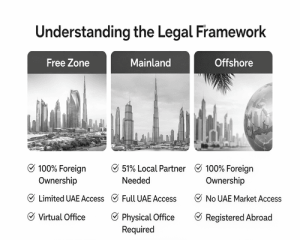
Before you start your business in Dubai from Pakistan, the most crucial decision is choosing the right jurisdiction. The jurisdiction determines your ownership structure, market access, costs, licensing requirements, and even visa eligibility. Selecting the wrong type can lead to unnecessary expenses, regulatory hurdles, or operational limitations. In Dubai, there are three main legal frameworks: Free Zone, Mainland, and Offshore. Each has its own advantages, costs, and compliance requirements. Let’s break them down in detail.
Free Zone Company
Free Zones are special economic zones in Dubai designed to attract foreign investors. They offer 100% ownership without the need for a local partner, streamlined registration processes, and sector-specific advantages. Free Zones are ideal if your goal is international trade, consultancy, e-commerce, or service-based businesses that do not require extensive local market presence.
Popular Free Zones:
- Dubai Multi Commodities Centre – Focused on trading, commodities, and corporate services. Offers excellent infrastructure and access to international business networks.
- Meydan Free Zone – Known for its flexible office options, fast licensing, and support for startups and SMEs.
- IFZA – One of the most cost-effective free zones with a simplified setup process and remote registration facilities.
Key Benefits of Free Zone Companies:
- 100% Foreign Ownership – No need for a UAE national partner.
- Remote Incorporation Possible – You can start the registration process entirely from Pakistan without being physically present in Dubai.
- Lower Initial Costs – Free zones often provide affordable packages, especially for startups and small businesses.
- Fast License Issuance – Many Free Zones can issue your trade license within 1–7 working days depending on the activity and documentation.
- Simplified Compliance – Free Zones have streamlined accounting and reporting requirements, making it easier for new entrepreneurs.
Ideal Business Activities for Free Zone Companies:
- E-commerce stores targeting global customers
- Digital marketing and IT consultancy
- Trading companies operating internationally
- Professional consultancy and advisory services
- Service-based startups with minimal UAE physical presence
Considerations:
While Free Zones are highly attractive, they have limitations:
- Restricted access to the UAE local market unless you hire a local distributor or agent
- Office space requirements may vary depending on the Free Zone
- Certain activities may require additional approvals
Free Zones are perfect for Pakistani entrepreneurs seeking a low-cost, quick, and fully owned setup in Dubai, especially if your target audience is international or you want to start operations without initially relocating to the UAE.
Mainland Company
A Mainland Company in Dubai is regulated by the Dubai Department of Economy and Tourism (DED), which ensures that your business complies with UAE commercial laws and can operate across the entire country. Unlike Free Zone companies, Mainland companies allow you to trade directly in the UAE market without any restrictions, making them ideal for entrepreneurs targeting local customers, government contracts, or retail operations.
Key Benefits of Mainland Companies
- UAE-Wide Market Access – A Mainland company can conduct business anywhere within Dubai and the wider UAE, including the ability to sell directly to customers, other businesses, or government entities without needing a local distributor. This is a significant advantage for businesses aiming for full market penetration.
- Eligibility for Government Contracts – Only Mainland companies are permitted to bid on government tenders and participate in public sector projects. This opens opportunities for larger, high-value contracts that can significantly boost revenue and credibility.
- Unlimited Visa Potential (Office Dependent) – The number of visas you can sponsor depends on the size of your office, giving flexibility for hiring staff or relocating family members. Mainland setups generally allow more visas compared to Free Zones, which is ideal for growing businesses.
- Broad Range of Activities – Mainland licenses cover a wide spectrum of commercial, professional, and industrial activities. This allows entrepreneurs to operate multiple lines of business under a single legal entity, providing more operational freedom.
- Full Legal Recognition – Being licensed by DED ensures your company is recognized by UAE authorities, banks, and other businesses. This can make business transactions, bank account setup, and contract enforcement smoother and more secure.
Best Suited For
- Local Trading – Selling products directly to UAE residents or businesses.
- Contracting – Construction, consultancy, and service contracts that require local presence.
- Retail Operations – Shops, showrooms, and customer-facing businesses.
- Service Providers Targeting Local Clients – Marketing agencies, law firms, or professional consultancies serving UAE-based clients.
Considerations
While Mainland companies offer full UAE market access, they do come with higher initial setup costs and stricter compliance requirements compared to Free Zones. You are required to have a physical office, and depending on your business activity, you may need a local service agent or partner for certain sectors.
In summary, Mainland companies are the ideal choice for Pakistani entrepreneurs looking to establish a strong local presence, bid for government contracts, and scale their operations across Dubai and the UAE.
Offshore Company
An Offshore Company in Dubai is a type of business entity designed primarily for international business, asset protection, and holding purposes. Unlike Free Zone or Mainland companies, offshore companies do not require a physical office in the UAE and do not automatically grant a UAE residency visa. They are ideal for Pakistani entrepreneurs who want to establish a legal presence in Dubai for international trade, investments, or corporate structuring without immediately operating in the local UAE market.
Key Features of Offshore Companies
- No Physical Office Requirement – Offshore companies do not need to rent or maintain a physical office in Dubai. This significantly reduces setup and ongoing operational costs, making offshore structures highly cost-effective for asset management or international trading purposes.
- No UAE Residency Visa – Unlike Free Zone or Mainland companies, an offshore entity does not automatically qualify its owner for a UAE residency visa. This means that entrepreneurs can legally own and operate a business without relocating to Dubai, which is particularly useful for investors managing multiple international operations from Pakistan.
- Used for International Holding Structures – Offshore companies are frequently used to hold shares in other companies, manage intellectual property, or act as a holding entity for investments abroad. This allows Pakistani investors to structure their global business portfolios efficiently, protect assets, and optimize tax planning.
- Confidential Ownership – Many offshore jurisdictions in Dubai provide privacy benefits, allowing shareholders and directors to remain confidential. This is especially advantageous for entrepreneurs who prefer discretion in ownership structures.
- Ease of Cross-Border Transactions – Offshore companies facilitate international banking, cross-border contracts, and global trading without the restrictions that local UAE regulations might impose on Mainland or Free Zone companies.
Ideal Uses for Offshore Companies
- Holding Companies – Managing investments or shares in other businesses globally.
- Asset Protection – Safeguarding personal or corporate assets under a legally recognized UAE entity.
- International Trade – Import-export operations not directly targeting the UAE market.
- Intellectual Property Management – Owning patents, trademarks, or copyrights under a Dubai entity.
Considerations
While Offshore companies provide flexibility, they come with limitations:
- They cannot conduct business directly in the UAE local market.
- They do not grant UAE residency or work visas.
- Certain banking operations may require additional documentation or corporate structure disclosures.
In summary, Offshore Companies are ideal for Pakistani entrepreneurs seeking a Dubai-based legal entity for international business, holding structures, or asset protection, without the need for physical presence or local market involvement. They complement Free Zone or Mainland setups for investors with global business ambitions.
Step-by-Step Process to Start a Business in Dubai from Pakistan (2026 Updated)
Establishing a business in Dubai from Pakistan requires careful planning, adherence to UAE regulations, and following a structured step-by-step process. Below is a comprehensive guide to ensure smooth company formation, licensing, visa approval, and banking setup in 2026.
Step 1: Choose Your Jurisdiction
The first and most critical step is selecting the right jurisdiction for your business. Your choice will determine your ownership rights, market access, visa eligibility, and operational flexibility.
- Free Zone – Ideal if your focus is international trade or online services. Offers 100% foreign ownership and simplified setup, with minimal office requirements.
- Mainland – Best for businesses targeting UAE local market, government contracts, or retail operations. Requires a physical office and allows unrestricted trading across the UAE.
- Offshore – Suited for holding companies, international trading, or asset protection. No UAE residency visa or local office required.
Tip: Evaluate your target market, business activity, and long-term goals before choosing the jurisdiction.
Step 2: Select Your Business Activity
Your chosen business activity determines several critical aspects of your company setup:
- License Type: Commercial, Professional, or Industrial
- Required Approvals: Certain activities may need additional government or regulatory approvals
- Cost: License fees and additional approvals vary depending on the activity
Examples:
- E-commerce or consultancy → Professional License
- Trading or import-export → Commercial License
- Manufacturing → Industrial License
Tip: Align your activity with your long-term business plan to avoid future restrictions.
Step 3: Reserve Trade Name
After selecting your activity, you need to reserve a trade name, which will serve as your company’s official identity.
-
Processing time: 1–2 working days
-
Guidelines:
- Avoid religious, political, or offensive words
- Name must align with business activity
- Some Free Zones allow multiple trade name options
Tip: Reserve a name that is simple, memorable, and aligns with your brand vision.
Step 4: Apply for Trade License
Once your trade name is approved, apply for a trade license according to your business activity:
- Commercial License – Trading, import/export, retail
- Professional License – Consultancy, IT services, digital marketing, service-based businesses
- Industrial License – Manufacturing, production, or industrial operations
Tip: Free Zones often provide pre-packaged licenses, while Mainland licenses may require more documentation and approvals.
Step 5: Obtain Entry Permit & Visa
All business owners must apply for a UAE visa to legally operate and reside. This process is handled through the Federal Authority for Identity and Citizenship.
Process Includes:
- Entry Permit: Initial approval to enter the UAE for business purposes
- Medical Test: Mandatory health check for visa issuance
- Emirates ID: Required for legal identification in Dubai
- Residency Stamping: Final step for your UAE residency
Tip: Keep all original documents handy, including passport copies and proof of business setup, to avoid delays.
Step 6: Open a Corporate Bank Account
A corporate bank account is essential for running your business smoothly, handling transactions, and meeting regulatory compliance.
Popular Banks for Pakistani Entrepreneurs:
- Emirates NBD
- Mashreq
Requirements Typically Include:
- Business plan detailing operations and revenue projections
- Source of funds documentation (to comply with anti-money laundering rules)
- UAE address proof (office or registered address depending on jurisdiction)
Tip: Many Free Zones assist with bank introductions to streamline account opening.
Additional Recommendations
Free Zone License Costs
- Approximate Range: AED 12,000 – 18,000 per year
- Free Zone licenses are generally more affordable than Mainland licenses.
- Many Free Zones offer package deals that include license, initial registration, and visa quota.
- Additional costs may apply if you require physical office space or need multiple visas.
Tip: Free Zone packages often include digital services like e-signatures, document processing, and virtual office setups, which can reduce overall expenses.
- Consider hiring a professional consultant to manage licensing, visa processing, and banking to reduce errors and save time.
- Keep track of license renewal dates and ongoing compliance requirements.
- Plan your first-year budget carefully, including license, office, visa, and operational costs.
Cost Breakdown for Starting a Business in Dubai from Pakistan (2026 Updated Estimate)
Understanding the costs involved in setting up a business in Dubai is crucial for Pakistani entrepreneurs. Dubai offers flexible options depending on the jurisdiction (Free Zone, Mainland, or Offshore), business activity, and the scale of operations. Below is a detailed breakdown of the main cost components and estimated budgets for 2026.
Mainland License Costs
- Approximate Range: AED 18,000 – 30,000 per year
- Mainland licenses are usually more expensive due to DED registration fees, office requirements, and compliance costs.
- Costs vary depending on the type of business activity (commercial, professional, or industrial) and office size.
Tip: Mainland licenses allow trading anywhere in the UAE, making them worth the higher investment if your business is locally focused.
Visa Costs
- Investor / Owner Visa: AED 3,000 – 7,000
- Includes medical testing, Emirates ID issuance, and visa stamping.
- Number of visas depends on the jurisdiction and office size.
Tip: Plan for additional visas if you intend to sponsor family members or employees.
Emirates ID
- Cost: Included in the visa fees
- Required for legal identification in Dubai
- Needed for banking, tenancy contracts, and official transactions
Office Space Costs
- Approximate Range: AED 5,000 – 15,000 annually (depending on jurisdiction and location)
- Free Zones allow virtual offices or flexi-desk options at lower costs.
- Mainland companies require a physical office with minimum space requirements based on business activity.
Tip: Evaluate whether your business truly needs a physical office initially, as opting for a Free Zone virtual office can save substantial upfront costs.
Bank Setup Costs
- Case-based and depends on the bank, account type, and required minimum balance
- Most banks will require a business plan, proof of source of funds, and UAE address
- Some banks may charge additional service fees for account maintenance
Tip: Free Zones often help new businesses with bank introductions, simplifying account opening for Pakistani investors.
Minimum Investment Range
For Pakistani entrepreneurs starting a business in Dubai, the total first-year investment can range between:
AED 15,000 – 35,000
This includes license fees, visa costs, Emirates ID, office space, and initial banking requirements.
Planning Tips:
- Budget extra for renewals, government approvals, and miscellaneous operational costs.
- Free Zone setups are generally more budget-friendly, while Mainland setups offer broader market access and higher scalability.
- Offshore companies have minimal setup costs but do not provide local UAE market access or residency visas.
Pakistan-Specific Compliance Considerations for Starting a Business in Dubai
When a Pakistani entrepreneur decides to start a business in Dubai, there are specific compliance requirements that must be carefully followed to ensure smooth company formation, licensing, and banking processes. Understanding these Pakistan-specific considerations can save time, reduce errors, and avoid unnecessary delays in 2026.
Passport Validity
- Your passport must be valid for at least six months at the time of application.
- Immigration authorities in Dubai strictly enforce this requirement for all entry permits, residency visas, and Emirates ID processing.
- Ensure that all family members or additional visa applicants also meet this requirement to prevent delays.
Source of Funds Documentation
- UAE banks require a clear demonstration of the origin of funds for corporate accounts and visa applications.
- Pakistani investors must provide supporting documents such as:
- Bank statements from Pakistan
- Proof of business ownership or income sources
- Transaction history and tax compliance records
-
Transparent documentation helps in avoiding banking rejections and ensures compliance with UAE anti-money laundering (AML) regulations.
Bank Account Considerations
- Some UAE banks may require an in-person visit by the account holder for verification, even if you are setting up remotely from Pakistan.
- Banks may also request additional documents such as a business plan, trade license copies, and proof of office address.
- Free Zones often assist with bank introductions, but it’s important to be prepared for potential extra requirements.
Remote Free Zone Setup
- Free Zone authorities offer the option to register your company remotely from Pakistan, reducing the need for immediate travel.
- You can submit applications, receive approvals, and even process initial documentation online.
- This flexibility makes Free Zones especially attractive for Pakistani entrepreneurs who want to start operations without relocating immediately.
UAE–Pakistan Trade Relations
- Strong trade relations between the UAE and Pakistan facilitate approvals for legitimate business applications.
- Pakistani investors often experience smoother licensing, visa, and banking processes compared to investors from other jurisdictions, provided all documentation is accurate and compliant.
- Maintaining a transparent business profile, valid financial records, and adherence to UAE regulations will significantly improve approval speed and reduce friction.
Summary & Recommendations
- Always ensure passport validity of 6+ months
- Maintain transparent and verifiable source of funds documentation
- Be prepared for possible in-person banking requirements
- Take advantage of remote Free Zone registration options to save time and costs
- Leverage UAE–Pakistan trade relations for faster approvals
By understanding these Pakistan-specific compliance considerations, entrepreneurs can reduce operational risks, avoid delays, and start their Dubai business confidently and legally.
Tax Structure in Dubai for Pakistani Entrepreneurs (2026 Update)
Understanding the tax structure in Dubai is a crucial step for Pakistani investors planning to start a business in the UAE. Dubai offers a highly tax-efficient environment compared to many other countries, which is one of the key reasons it has become a global hub for business and investment. The system is regulated by the Federal Tax Authority, which ensures compliance with UAE tax laws while promoting a business-friendly ecosystem.
Corporate Tax in Dubai
- Rate: 9% for businesses exceeding the threshold of AED 375,000 in profits (as per 2023–2026 regulations).
- This is a recently implemented corporate tax, intended to align the UAE with international standards while remaining competitive globally.
- Startups and small businesses with profits below the threshold are generally exempt, making Dubai particularly attractive for new entrepreneurs.
- Corporate tax applies only to business profits, not to personal income or capital gains from non-UAE sources.
Tip: Ensure proper accounting and bookkeeping to calculate taxable profits accurately. Free Zones often have specific exemptions or reduced rates, depending on the business activity.
Personal Income Tax
- Rate: 0% — Dubai imposes no personal income tax on salaries, dividends, or other personal earnings.
- This makes the UAE an attractive location for Pakistani entrepreneurs and professionals who want to maximize personal wealth while reinvesting in their business.
- Even for employees hired under your company, there is no withholding personal income tax, which simplifies payroll management.
Tip: While Dubai doesn’t levy personal income tax, ensure that you comply with Pakistan’s tax reporting if required for global income.
Value Added Tax (VAT)
- Rate: 5% on most goods and services, applicable if your business meets the registration threshold (AED 375,000 annual turnover).
- VAT applies to retail sales, services, and imported goods, but certain exports and Free Zone transactions may be exempt or zero-rated.
- Proper VAT registration and filing are mandatory to avoid penalties.
Tip: Engage a tax consultant or accounting service to manage VAT compliance effectively, especially if your business handles international transactions.
Why Dubai is Tax-Efficient for Pakistani Entrepreneurs
- Low Corporate Tax: Only 9% on profits above the threshold, significantly lower than many other countries.
- No Personal Income Tax: You retain 100% of your earnings.
- Free Zones with Tax Benefits: Many Free Zones offer corporate tax holidays or reduced rates for specific activities.
- Simplified Reporting: Dubai’s regulatory framework is designed to facilitate compliance while minimizing administrative burden.
- International Trade-Friendly: Dubai’s tax system allows easy cross-border transactions without double taxation for properly structured international operations.
Summary
Dubai’s 2026 tax structure ensures that Pakistani investors can maximize profits, reduce operational costs, and reinvest earnings into growth. By combining Free Zone or Mainland setup with proper accounting and VAT compliance, entrepreneurs can enjoy both local and international business advantages while keeping tax obligations transparent and manageable.
Visa & Residency Options for Pakistani Entrepreneurs in Dubai (2026)
Obtaining the correct visa is a critical step for Pakistani entrepreneurs who want to legally live and operate a business in Dubai. The UAE government provides structured residency and investor visa programs that are closely linked to your business setup, office size, jurisdiction, and business activity. Proper planning ensures smooth immigration approval and compliance with all UAE regulations.
Investor / Owner Visa
As a Pakistani investor, you are eligible to receive a 2-year residency visa, which allows you to legally reside in Dubai while managing your business operations. This visa is renewable as long as your business remains active and compliant with local regulations.
Key Features:
- Duration: 2 years, renewable
- Eligibility: Business owner or shareholder in a licensed UAE company (Free Zone, Mainland, or qualifying Offshore setup)
- Includes: Emirates ID issuance and full legal recognition in the UAE
- Dependent on: Jurisdiction, business activity, and office size
Tip: For Free Zone setups, certain authorities may allow remote application for your investor visa, which can save travel and administrative time.
Emirates ID
The Emirates ID is a mandatory identification card issued to all UAE residents. It is required for:
- Bank account setup
- Signing contracts
- Government and utility services
- Immigration and travel formalities
Included in visa process: Most investor visas automatically include Emirates ID issuance as part of the residency approval.
Ability to Sponsor Family
One of the major benefits of the investor visa is the ability to sponsor family members, including spouse and children, provided certain conditions are met:
- Office size: The number of sponsored family members may depend on the physical office space registered under your company
- Financial capability: You must demonstrate sufficient income to support dependents
- Jurisdiction: Free Zones and Mainland have slightly different sponsorship rules
- Documentation: Marriage certificates, birth certificates, and passports of dependents are required
Tip: Planning your office space wisely can allow you to maximize visa quotas and bring your family to the UAE.
Factors Affecting Visa Eligibility
- Office Size & Type – Mainland companies require a physical office, and visa quotas are linked to office space. Free Zones often provide flexible office options, including virtual offices, but this may affect the number of visas you can sponsor.
- Jurisdiction – Free Zone, Mainland, or Offshore setups have different visa entitlements and sponsorship capabilities.
- Business Activity – Certain professional or commercial activities may require additional approvals before a visa can be issued.
Additional Recommendations
- Start visa applications as soon as your trade license is approved to avoid delays.
- Maintain a valid passport with at least six months’ validity.
- Ensure all documents are translated and attested if required by UAE authorities.
- Consider professional consultancy to manage the entire visa process efficiently from Pakistan.
Summary
By obtaining an investor visa and Emirates ID, Pakistani entrepreneurs can legally reside, operate their business, and sponsor family members in Dubai. Careful attention to office requirements, jurisdiction, and activity type ensures compliance and a smooth immigration process.
Low Investment Business Ideas for Pakistani Entrepreneurs in Dubai (2026)
Dubai offers a wide range of opportunities for Pakistani investors who want to start a business with a relatively low initial investment. By choosing the right jurisdiction, particularly Free Zones, entrepreneurs can establish cost-efficient startups while benefiting from 100% ownership, streamlined registration, and access to international markets. Here are some practical options for 2026:
E-Commerce Store
- Description: Sell products online locally or internationally through platforms like Shopify, Amazon, or your own website.
- Why It Works: Minimal physical presence required; Free Zones allow remote setup.
- Estimated Initial Investment: AED 15,000 – 25,000 (license + virtual office + setup costs).
- Ideal Jurisdictions: DMCC Free Zone, IFZA, Meydan Free Zone.
-
Tips: Focus on niche products, digital marketing strategies, and logistics partnerships for cost-efficient scaling.
Digital Marketing Agency
- Description: Provide online marketing services such as SEO, social media management, and content creation.
- Why It Works: Dubai has a growing demand for digital services; no heavy inventory costs.
- Estimated Initial Investment: AED 15,000 – 20,000 (license + visa + office setup if required).
- Ideal Jurisdictions: Free Zones with Professional Licenses like Dubai Multi Commodities Centre (DMCC).
-
Tips: Start as a home-based or virtual office business; hire freelancers to minimize operational costs.
IT Consultancy
- Description: Offer IT solutions, software development, or tech support to businesses locally or internationally.
- Why It Works: Strong demand for IT services in UAE; Free Zone licensing allows international client servicing.
- Estimated Initial Investment: AED 15,000 – 25,000 (license + remote office setup).
- Ideal Jurisdictions: Tech-focused Free Zones or Professional License Free Zones.
- Tips: Maintain updated certifications and target both UAE-based and international clients.
General Trading Company
- Description: Import and export consumer goods, electronics, or specialty products between Pakistan and UAE.
- Why It Works: Dubai is a strategic trading hub for GCC and international markets.
- Estimated Initial Investment: AED 20,000 – 35,000 (license + visa + warehouse/office).
- Ideal Jurisdictions: Free Zones like DMCC or Mainland if targeting UAE local market.
- Tips: Understand UAE import/export regulations, shipping logistics, and VAT requirements.
Import/Export Business
- Description: Facilitate cross-border trade of products between Pakistan and UAE, including textiles, food items, and industrial goods.
- Why It Works: Strong trade relations between Pakistan and UAE; Free Zone setups support international trading.
- Estimated Initial Investment: AED 20,000 – 35,000 (license + visa + warehouse/office).
- Ideal Jurisdictions: Free Zone or Mainland depending on market access.
- Tips: Focus on high-demand products, maintain supplier contracts, and comply with UAE trade laws.
Why Free Zones are Ideal for Low-Cost Startup Models
- Remote Setup: Start your business from Pakistan without immediate relocation.
- 100% Foreign Ownership: No local partner required.
- Lower Costs: Many Free Zones offer package deals for startups, including license, visa quota, and virtual office.
- Faster Approvals: Trade licenses and visas are processed quickly, allowing faster market entry.
Tip: Free Zones are particularly beneficial for service-based, online, and trading businesses, as they reduce overheads while providing international reach.
| Feature | Free Zone | Mainland |
|---|---|---|
| Ownership | 100% | 100% (most sectors) |
| UAE-wide trading | Limited (needs distributor) | Allowed |
| Cost | Lower | Higher |
| Office requirement | Flexible | Mandatory |
| Government contracts | No | Yes |
Common Mistakes to Avoid When Starting a Business in Dubai from Pakistan (2026)
Starting a business in Dubai can be highly rewarding for Pakistani entrepreneurs, but many newcomers make avoidable mistakes that result in delays, higher costs, or legal complications. By understanding and planning for these pitfalls, you can ensure a smooth and compliant business setup.
Choosing the Wrong Business Activity
- Selecting an activity that doesn’t align with your business goals or target market can cause license rejections or restrictions later.
- Certain activities require additional government approvals, especially in Mainland setups.
- Tip: Carefully match your business activity with your target audience, jurisdiction (Free Zone or Mainland), and long-term goals.
Ignoring Banking Compliance
- UAE banks have strict Know Your Customer (KYC) and anti-money laundering (AML) requirements.
- Lack of proper documentation (source of funds, business plan, UAE address) can lead to account rejection.
- Tip: Prepare all necessary documents in advance and consider using Free Zone bank introductions to simplify the process.
Underestimating Renewal Fees
- Many entrepreneurs focus only on initial setup costs and forget about annual license, visa, and office renewals.
- Renewal fees can add significant costs to your operating budget if not planned for.
- Tip: Include license renewal, visa renewal, and office rent in your first-year and ongoing budget planning.
Not Planning Visa Quota
- Your office size, jurisdiction, and license type determine how many visas you can sponsor.
- Failing to plan for visas may limit your ability to bring in employees or family members.
- Tip: Evaluate your office space needs and consider future expansion when determining your visa quota.
Selecting the Wrong Free Zone
- Different Free Zones specialize in different business activities. Choosing the wrong one may result in higher costs, activity restrictions, or inability to trade in your target market.
- Tip: Research Free Zones carefully, considering costs, licensing speed, visa quota, activity compatibility, and support services.
Summary
By avoiding these common mistakes, Pakistani entrepreneurs can:
- Reduce delays in license and visa approvals
- Avoid unnecessary expenses
- Ensure compliance with UAE laws and banking regulations
- Maximize operational efficiency and market access
Key Advice: Take time to plan your business activity, select the right jurisdiction, manage banking and visa requirements, and account for renewals before starting operations in Dubai.
Timeline Breakdown for Starting a Business in Dubai from Pakistan (2026)
A clear understanding of the time required for each stage of business setup is essential for Pakistani entrepreneurs planning their Dubai expansion. While timelines may vary depending on jurisdiction, business activity, and document readiness, the following is an updated 2026 estimate:
Stage 1: Trade Name Reservation
- Time Required: 1–2 working days
- Description: Trade name approval is the first step in formalizing your business identity. Authorities review the name for compliance with UAE regulations, ensuring it is unique, appropriate, and aligned with your business activity.
- Tip: Submit multiple name options to avoid delays in case the first choice is rejected.
Stage 2: Trade License Approval
- Time Required: 3–7 working days
- Description: After reserving the trade name, your license application is processed. Free Zones typically offer faster approvals, while Mainland applications may take longer due to additional regulatory checks.
- Tip: Ensure all supporting documents are accurate and complete to avoid back-and-forth with authorities.
Stage 3: Visa Processing & Emirates ID
-
Time Required: 5–10 working days
-
Description: Once your license is approved, the investor or owner visa application can begin. This includes:
- Entry permit issuance
- Medical fitness test
- Emirates ID registration
- Residency stamping
-
Tip: Prepare all required documents, including passport copies, proof of business setup, and attested Pakistani documents, to speed up the process.
Stage 4: Corporate Bank Account Opening
- Time Required: 1–4 weeks
- Description: Banks require verification of your trade license, Emirates ID, business plan, and source of funds. Some banks may also request an in-person visit. Free Zones often provide bank introductions to simplify account opening.
- Tip: Choose banks familiar with Free Zone clients to reduce delays.
Average Total Timeline
- Estimated Duration: 10–20 working days
- Free Zone setups are typically faster due to streamlined processes and online applications.
- Mainland setups may take slightly longer due to office approvals, additional licenses, and regulatory checks.
Summary
By following this structured timeline, Pakistani entrepreneurs can plan their Dubai business setup efficiently, avoiding unnecessary delays and ensuring all legal, visa, and banking requirements are completed on schedule.
Pro Tip: Keep a checklist for each stage, track progress, and communicate proactively with Free Zone or Mainland authorities to ensure smooth operations.
Risk Factors & Hidden Costs for Pakistani Entrepreneurs in Dubai (2026)
While Dubai offers a highly attractive business environment, it’s important for Pakistani entrepreneurs to be aware of potential risks and hidden costs that can impact your startup budget, timeline, and operations. Proactive planning and professional guidance can help mitigate these risks effectively.
Bank Rejection Risk
- UAE banks have strict Know Your Customer (KYC) and anti-money laundering (AML) requirements.
- Incomplete documentation, unclear source of funds, or inconsistencies can result in account rejection.
- Mitigation: Prepare all documents carefully, maintain a clear business plan, and use Free Zone bank introductions to improve chances of approval.
Compliance Delays
- Regulatory approvals for trade license, visas, or office setup may be delayed if documentation is incomplete or inconsistent.
- Mainland businesses are more prone to delays due to DED approvals and additional government checks.
- Mitigation: Ensure proper documentation, follow official guidelines, and consider hiring a professional consultant to manage the process.
Office Lease Obligations
- Mainland companies require a physical office, and lease contracts may impose long-term obligations.
- Unexpected rent increases, maintenance, or utility costs can impact your budget.
- Mitigation: Consider Free Zone virtual offices for low-cost startups or carefully review Mainland office contracts before signing.
Visa Quota Limits
- The number of visas you can sponsor is linked to office size, license type, and jurisdiction.
- Not planning visa quotas in advance may prevent you from hiring staff or sponsoring family members.
- Mitigation: Evaluate office space needs carefully and plan your visa quota according to business growth.
Annual Renewal Fees
- Annual costs for license renewal, office rent, and visa renewals can add up significantly if not accounted for.
- Entrepreneurs sometimes underestimate the recurring expenses, which can create cash flow challenges.
- Mitigation: Include all recurring fees in your first-year and ongoing budget planning to ensure financial stability.
Key Advice
- Engage a trusted business setup consultant who is familiar with Pakistani investor requirements.
- Maintain transparent financial records and comply with UAE regulations to reduce the risk of rejection or delays.
- Review all contracts and fees upfront to avoid surprises.
Summary
By anticipating these risk factors and hidden costs, Pakistani entrepreneurs can make informed decisions, reduce operational challenges, and ensure a smooth, compliant, and cost-efficient business setup in Dubai.
Why Work with Professional Consultants When Starting a Business in Dubai from Pakistan
Starting a business in Dubai remotely from Pakistan can be highly rewarding, but it involves several complex steps that, if not handled correctly, can lead to delays, extra costs, or compliance issues. This is where professional business consultants can make a significant difference.
Challenges of Remote Setup
When starting a business from Pakistan, entrepreneurs face several logistical and regulatory challenges:
- Legal Documentation: Preparing and submitting all required documents to Dubai authorities, including trade license applications, visas, and Emirates ID processing.
- Authority Coordination: Interacting with Free Zone authorities, Mainland departments, and immigration authorities on your behalf.
- Bank Introductions: Navigating UAE banking procedures, KYC requirements, and account approvals.
- Compliance Handling: Ensuring your business adheres to UAE laws, regulations, and licensing requirements throughout the setup process.
Without professional guidance, these steps can become time-consuming, confusing, and prone to errors.
How Consultants Add Value
Working with an experienced business setup firm ensures that your remote Dubai setup is efficient, legal, and cost-effective.
Key Benefits:
- Correct Activity Selection – Experts help you choose a business activity that aligns with your target market, jurisdiction, and long-term goals.
- Cost Transparency – Consultants provide detailed breakdowns of setup costs, renewal fees, visa charges, and hidden expenses.
- Faster Approvals – Established relationships with Free Zone authorities, Mainland departments, and banks help speed up license and visa processing.
- Bank-Ready Documentation – Consultants prepare all necessary documents for UAE banks, reducing the risk of account rejection and delays.
Additional Advantages
- Guided Decision-Making: Consultants help evaluate Free Zone vs Mainland vs Offshore, license types, office requirements, and visa quotas.
- Risk Reduction: By anticipating hidden costs, compliance issues, and banking hurdles, consultants reduce operational risk.
- Time-Saving: Remote entrepreneurs can focus on business strategy while the consultant handles all procedural steps.
Summary
Engaging a professional business setup consultant is especially valuable for Pakistani investors aiming to expand into Dubai in 2026. They ensure that your company setup is compliant, fast, and cost-efficient, providing peace of mind and letting you focus on growing your business rather than navigating bureaucracy.
Final Thoughts: Starting a Business in Dubai from Pakistan (2026 Outlook)
Dubai continues to be one of the most attractive destinations for Pakistani entrepreneurs looking to expand regionally or globally in 2026. With the right planning, jurisdiction choice, and compliance measures, your business can thrive in this dynamic, tax-efficient, and investor-friendly environment.
Why Dubai is Ideal for Pakistani Entrepreneurs
- Legally Structured: Clear frameworks in Free Zones, Mainland, and Offshore setups ensure your business operates within UAE laws while protecting ownership rights.
- Fast Setup: Streamlined processes and remote Free Zone registration allow entrepreneurs to start operations quickly, sometimes within 10–20 working days.
- Tax-Efficient: Low corporate tax (9% above threshold), 0% personal income tax, and VAT regulations make Dubai a financially attractive option for investors.
- Globally Scalable: Free Zones provide international trading privileges, and Dubai’s strategic location enables expansion into GCC and global markets.
Key Takeaways for 2026
- Choose the Right Jurisdiction: Free Zone for cost efficiency and international trade, Mainland for local UAE access, Offshore for holding and international operations.
- Plan Your Costs Transparently: Include license fees, visas, office space, banking, and renewal costs to avoid budget surprises.
- Ensure Compliance: Proper documentation, source of funds verification, and adherence to UAE regulations are essential for smooth approvals.
- Leverage Professional Consultants: Consultants help with activity selection, licensing, banking, visas, and risk mitigation.
- Focus on Scalable Business Models: Low-investment businesses like e-commerce, digital marketing, and consultancy services can grow rapidly in Dubai’s ecosystem.
Conclusion
Starting a business in Dubai from Pakistan in 2026 is more accessible than ever, thanks to updated regulations, Free Zone flexibility, and strong UAE–Pakistan trade relations. With strategic planning, proper guidance, and compliance alignment, Dubai can serve as your regional or global expansion hub, enabling Pakistani entrepreneurs to operate efficiently, grow sustainably, and maximize profitability.
Ready to Start Your Dubai Business?
Don’t navigate the setup alone! Partner with expert consultants to handle licensing, visas, banking, and compliance so you can focus on growing your business.
Contact Farooqi & Co today and start your Dubai journey!
FAQs
What is the easiest way for a Pakistani to start a business in Dubai?
The easiest approach is to set up a company in a Free Zone, as it allows 100% foreign ownership, remote registration, and lower costs compared to Mainland setups.
How much money do I need to start a business in Dubai from Pakistan?
The minimum investment typically ranges from AED 15,000 to 35,000, including license fees, visa, Emirates ID, office space, and initial banking setup. Costs vary depending on jurisdiction and business activity.
Can I start my Dubai business entirely from Pakistan?
Yes, especially in Free Zones, you can complete most steps remotely, including trade name registration, license application, and visa submission, though some banks may require an in-person visit.
What visa options are available for Pakistani investors?
Pakistani entrepreneurs are eligible for a 2-year investor/residency visa, which includes an Emirates ID and allows family sponsorship (subject to office size and financial capability).
Which Free Zones are best for low-investment startups?
Popular options for Pakistani investors include DMCC, Meydan Free Zone, and IFZA, which offer low-cost licenses, virtual office options, and remote company registration.
What are the main risks when starting a business in Dubai from Pakistan?
Common risks include bank account rejection, compliance delays, underestimating renewal fees, visa quota limits, and choosing the wrong Free Zone or business activity. Proper consultation helps mitigate these risks.
Do I need to pay taxes in Dubai as a Pakistani entrepreneur?
Dubai has a 9% corporate tax on profits above AED 375,000, 0% personal income tax, and 5% VAT if applicable. Free Zones often offer tax exemptions or reduced rates, making Dubai very tax-efficient compared to other jurisdictions.